A cascade is the moment a puzzle board keeps working after you have stopped. You make one move, a group clears, the pieces above drop into the gap, and the new arrangement happens to form another match. That second clear is not luck in the way most people assume, and understanding why changes how you plan a level.
The three steps every cascade repeats
Whatever the game calls it — tumble, cascade, chain, fall — the loop underneath is the same three steps, repeated until nothing new forms:
- A group is removed, either because you matched it or because a power-up cleared it.
- Everything above the gap falls down, and fresh pieces enter from the top edge.
- The board is checked again. If the new arrangement contains a valid group, it clears too, and the loop starts over.
The important part is step three. The game does not ask whether you intended the second clear. It only checks the board state. That is why a single well-placed move at the bottom of a crowded board can run for four or five rounds, while the same move near the top does almost nothing: there is less material above it to fall and re-arrange.
Swap games and collapse games behave differently
Two families of board sit behind almost every title in this genre, and they reward opposite habits.
Swap boards
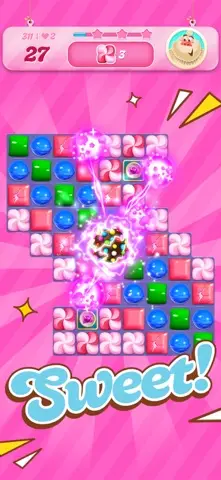
You exchange two neighbouring pieces to line up three or more. The board is dense and every piece has a fixed neighbourhood, so the useful question is which single swap opens the most follow-on matches. Candy Crush Saga is the reference point here, and it has been on the stores since 2012-11-14.
Collapse boards
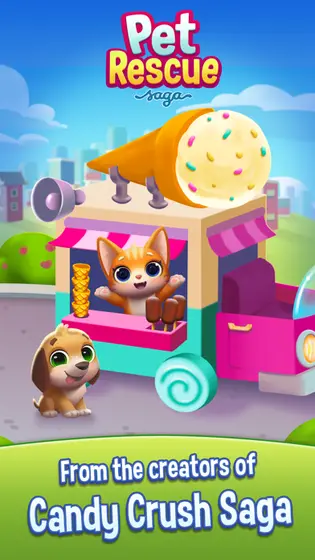
You tap a group of touching same-colour blocks and the whole group disappears at once, with no minimum of three in a line. Pet Rescue Saga works this way. Because groups merge as the board settles, the correct habit is the reverse of a swap game: clearing a small group early is usually a waste, because two small groups often fall into one large group on their own.
A rule that holds in both families: work from the bottom up. Material only falls downwards, so a clear at the bottom re-arranges the entire column above it, while a clear at the top re-arranges almost nothing.
Why scoring rewards the second clear more than the first
Most of these games apply a rising value to each round of a single chain. The first clear pays its face value, the second pays more, the third more again. The exact numbers differ per title and are not published, but the shape is consistent enough that you can plan around it: one move that produces four rounds is worth far more than four separate moves that produce one round each.
This is also why the games feel generous at the start of a level and tight at the end. Early on the board is full, so chains run long. Once you have cleared most of the material, there is nothing left to fall, and the same move produces a single clear.
What a chain reaction cannot do
It cannot rescue a level goal you have not been working towards. In a timed level, a long chain buys you score but not moves. In a collect-goal level, a spectacular chain in the wrong colour is close to worthless — see our guide to collect-goal levels for why that trap catches so many players.
It also cannot be relied on. The pieces entering from the top are generated as the board refills, so the length of a chain has a random element in every one of these games. Planning improves your average result over a session; it does not make any single level deterministic.
Practical takeaways
- Look at the bottom third of the board first. That is where a move does the most work.
- In collapse games, let small groups grow before you tap them.
- Count what the level actually asks for before you chase a long chain.
- Treat chain length as an average across a session, not a plan for one level.
Store links go to the official listings. Prices, in-app purchases and availability are shown on the store page and can change at any time.